
Stemless Red Chilli — Food-Safe Grade for Premium Markets
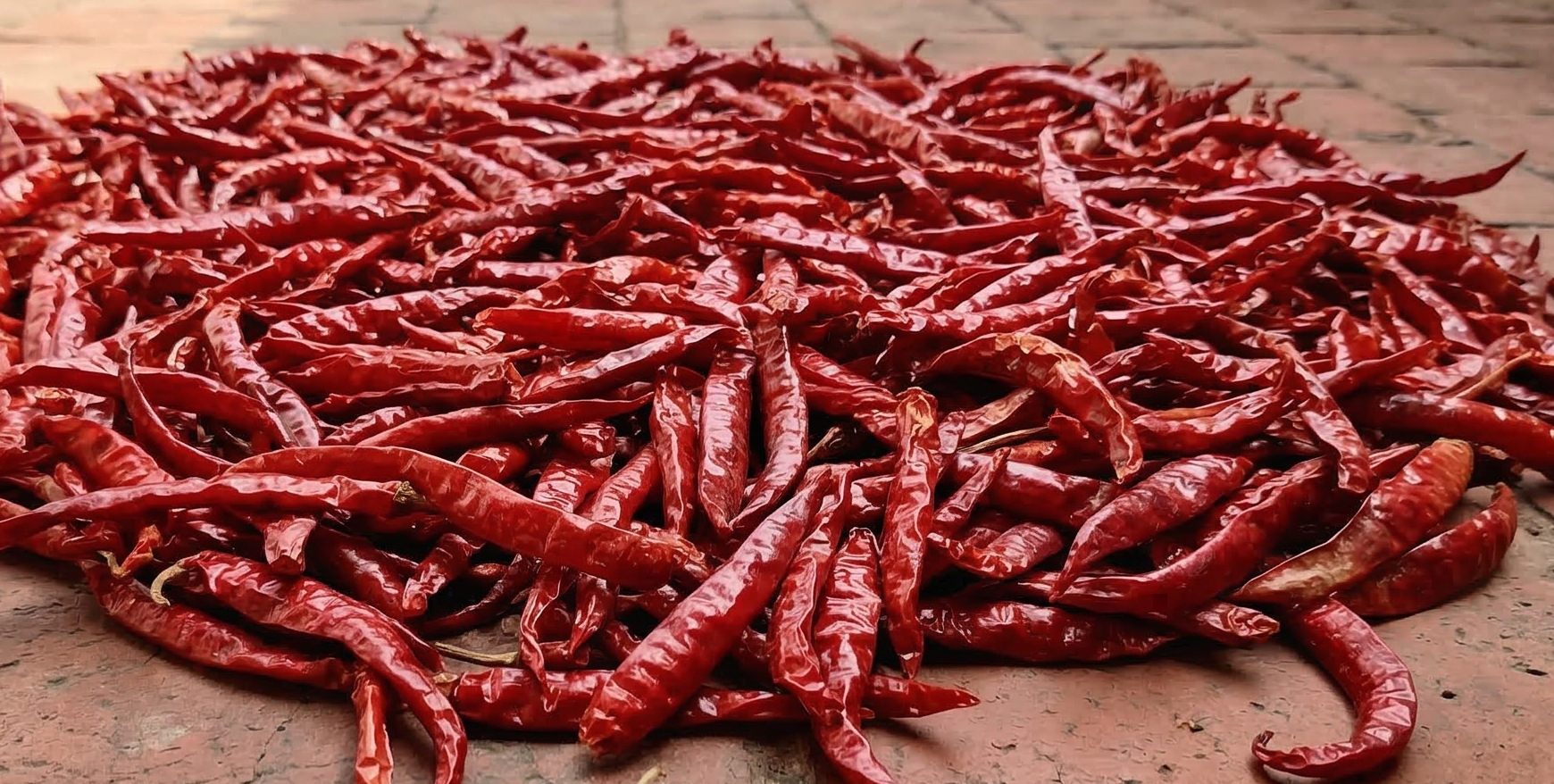
Stemless red chillies are whole dried chillies that have had the calyx (cap) and stem mechanically and manually removed, leaving only the clean chilli pod. This processing step is required by food safety regulations in the EU, USA, and other premium import markets — and is the preferred specification for food manufacturers worldwide who demand the highest levels of hygiene in their raw material inputs.
Product Specifications
Key Highlights
- Stem removal eliminates the primary source of microbial contamination in whole chillies
- Required by many EU and US food safety import regulations for processed food inputs
- Uniform, clean appearance ideal for premium retail packaging applications
- Reduced weight (no stems) means more usable chilli per kg shipped
- Available in all major Guntur chilli varieties — Teja S17, Sannam, Byadgi, 334
Available in All Major Guntur Varieties
Stemless processing is available for all Guntur red chilli varieties. Choose the variety that matches your application requirements — the stemless specification adds a layer of food safety processing to any base variety.
Why Stemless Chilli?
Food Safety Regulations
The chilli stem (peduncle) and calyx (cap) are the parts of the chilli pod that have the highest surface area relative to volume, the highest moisture retention, and the most direct contact with soil during cultivation. These characteristics make them the primary site for microbial contamination — including mold, bacteria, and in some cases aflatoxin-producing fungi. By removing the stem and calyx, the microbial load on the dried chilli pod is significantly reduced.
Many food safety regulatory frameworks now require or strongly prefer stemless chillies for food processing applications. The European Union's food hygiene regulations (EC 852/2004) require food business operators to ensure that raw materials do not constitute a source of contamination. For chilli processors and food manufacturers, this effectively means that stemless chillies — which have had the highest-contamination-risk portion removed — are preferred or mandated inputs.
In the USA, FDA's Food Safety Modernization Act (FSMA) requirements for preventive controls place responsibility on food manufacturers to manage known contamination risks in raw materials. Specifying stemless chillies is an established risk-reduction practice that is increasingly written into procurement specifications for US food facilities.
Beyond regulatory compliance, the commercial rationale for stemless chilli is straightforward: stems add weight without adding food value, and they create processing complications in grinding and extraction operations. Food manufacturers who purchase stemless chillies pay for a higher proportion of usable pod material per tonne, simplifying their own processing and reducing waste.
Export Markets Requiring Stemless
The following markets most commonly specify stemless chillies for food industry procurement: European Union (food processing sector), United States (FSMA-compliant facilities), Japan (high food safety standards), Australia and New Zealand (strict import hygiene requirements), and Middle East (premium food manufacturing sector). While whole chillies with stems continue to dominate total trade volumes, the share of stemless in global chilli trade has been growing consistently as food safety requirements tighten globally.
Our Stemless Processing at Gaman Impex
Producing genuine food-safety-grade stemless chillies requires more than simply removing visible stems. At Gaman Impex, our stemless processing follows a comprehensive multi-stage protocol designed to deliver the lowest possible contamination risk in the finished product.
Incoming Material Inspection
Raw dried chillies received from the market undergo initial quality inspection for color, moisture, pest damage, and foreign matter before entering the stemless line. Only lots meeting our baseline quality standards are accepted for stemless processing.
Pre-Cleaning & Scalping
Chillies pass through a scalping screen that removes loose dust, broken material, and large foreign particles before the de-stemming stage. This reduces the contamination load entering the de-stemming machine and protects the machine from jamming on large debris.
Machine De-Stemming
Our automated de-stemming machines use a precisely calibrated mechanical process to grip and pull the calyx and stem from each chilli pod without damaging the pod body. The machine is adjusted based on pod size and variety to maximize removal efficiency while minimizing pod breakage.
Manual Inspection & Hand Picking
After machine de-stemming, chillies pass over a manual inspection conveyor where trained workers remove any pods with remaining partial stems, calyx fragments, or visible defects. This human oversight step achieves the "NIL extraneous matter" standard that machine processing alone cannot guarantee.
Final Cleaning & Aspiration
A final air aspiration pass removes fine dust and light material generated during the de-stemming process. This step ensures the finished stemless chilli meets the strict foreign matter limits required by export market food safety programs.
Moisture Verification & Packing
Moisture content is verified on each batch before packing to ensure it meets the ≤ 10% standard required for stemless export grade. Chillies are then packed in food-grade PP bags with inner PE liners, sealed, and labelled with batch number, variety, moisture content, and origin information for full traceability.
Stemless vs Whole Chilli — A Buyer's Guide
Both whole (with stem) and stemless chillies have their place in the global chilli trade. The right specification depends on your regulatory environment, processing needs, and target product category.
| Factor | Stemless Chilli | Whole Chilli (With Stem) |
|---|---|---|
| Food Safety Risk | Lower (source of contamination removed) | Higher (stem is highest-risk portion) |
| EU/US Compliance | Preferred/Required for food processing | Acceptable for some applications |
| Price Per Tonne | Higher (additional processing cost) | Lower (minimal processing) |
| Usable Pod Ratio | Higher (no stem weight) | Lower (stem accounts for 3–6% of weight) |
| Ideal For | Food processors, EU/US import, premium retail | Traditional trade, spice markets, industrial extract |
| Appearance | Uniform, clean pod only | Full pod with stem attached |
| Moisture Standard | ≤ 10% (stricter) | ≤ 12% (standard) |
| Microbial Load | Significantly lower | Higher relative to stemless |
For food manufacturers operating in the EU or USA, or supplying retail products where food safety certifications are required, stemless chillies are the recommended specification. For high-volume industrial extraction operations in Asia where the stem removal step occurs at the processing facility, whole chillies may be commercially preferred due to lower cost per tonne. Gaman Impex can supply either specification across all major Guntur chilli varieties — contact us to discuss your requirements.
Order Stemless Red Chilli — Food-Safe Export Grade
Available in Teja S17, S4 Sannam, Byadgi, and 334 varieties. Full documentation, phytosanitary certificate, and COA provided. Trial orders welcome.
WhatsApp Inquiry Get Quote